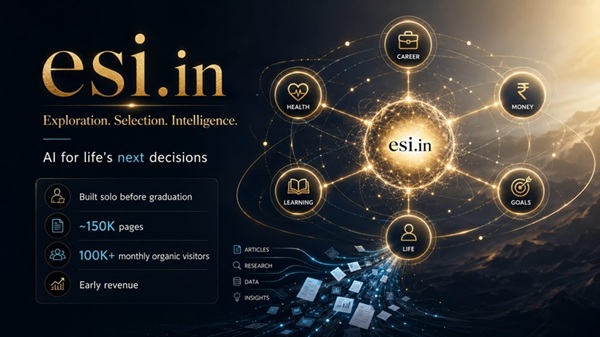
Built largely by one BITS Pilani (H) student, esi.in has grown to around 150,000 useful pages, attracted over 1 lakh organic visitors a month with over 10 Lac organic impressions and already begun generating revenue — offering a glimpse of what a single builder can now create with AI.
Mumbai, August 2026: A few years ago, building a technology platform with around 150,000 pages, AI-powered tools, personalised user journeys, cloud infrastructure, payments, search-driven acquisition and more than 1 lakh monthly organic visitors would almost certainly have required a sizeable team, time and resources
esi.in was built by one student.
No employees.
No development agency.
No freelancers.
No outsourced technology team.
And much of it was built before its founder had even graduated from college.
Vyom Vyas began building esi.in while completing his final semester at BITS Pilani, where he pursued a dual degree in Electrical and Electronics Engineering and Mathematics, along with a minor in Data Science.
At the same time, he was completing his mandatory internship and other academic requirements. ESI was therefore not being built as a full-time startup with a funded engineering team behind it. It was being put together largely in spare hours every week by a student experimenting with what could now be created by combining software, data, AI and relentless iteration.
By the time he graduated, that experiment had already become a substantial live internet platform.
Today, esi.in spans roughly 150,000 pages and attracts more than 1 lakh organic visitors every month. Users arrive through thousands of different intents across careers, resumes, education, STEM, colleges, universities, health, hospitals, finance, insurance, calculators, directories and everyday decisions.
The platform has also begun recording early payments from users through monetisation experiments.
The amounts themselves are not the story.
The more interesting signal is that a platform built by one student, initially without a sales organisation or large marketing budget, has already moved from being discovered organically to having users willing to pay for selected tools and experiences.
A different kind of AI story
Most conversations around artificial intelligence focus on what large companies can automate or how existing businesses can become more productive.
The story of esi.in points to another possibility: how dramatically AI may change the amount of technology a single person can create.
Vyom has worked across the frontend, backend, data architecture, AI integrations, analytics, SEO, cloud infrastructure, product design, testing and deployment himself.
AI has not simply been added as a chatbot on top of the product. It has been used extensively throughout the process of imagining, building, testing and extending the platform.
The result is an unusually broad product built with unusually little organisational infrastructure.
That breadth is deliberate.
The thesis behind ESI is that people’s important decisions rarely fit neatly inside individual categories.
Someone considering a new job may also need to think about salary, skills, location, family commitments and financial goals.
Someone planning to buy a home may need to consider not just the EMI, but liquidity, investments, insurance, career stability and retirement.
A student choosing a college may care about rankings, course fit, affordability, location and where that education could eventually lead.
Most websites address one fragment of such a decision. ESI is being built to connect the fragments.
From 150,000 pages to one person’s universe
The large public surface of esi.in serves as the discovery layer.
A user may arrive looking for a college, hospital, resume tool, career guide, EMI calculator, retirement calculation, Stem resource or one of thousands of other things.
The next phase of ESI is substantially more ambitious.
The company is developing My ESI, a user-controlled personal context layer designed to progressively understand the parts of an individual’s life that they choose to share.
That may begin with something as simple as a resume or a goal.
Over time, a user may choose to add professional history, education, financial information, investments, insurance, assets, liabilities, tax records, health information, preferences, upcoming decisions and other relevant context.
The idea is not to force somebody to complete a huge profile.
My ESI is being designed to start with whatever information is available, become useful immediately, and improve incrementally as more context is provided.
One document may improve one answer.
Another piece of information may reveal an important connection.
Eventually, scattered information begins becoming a personal decision graph.
Then comes ESI Next
Sitting above My ESI is ESI Next, the emerging personal decision assistant.
The difference is subtle but important.
A general AI system can answer:
“How much emergency fund should someone have?”
ESI Next is being built to eventually answer:
“How much emergency fund should I have?”
The second question may require understanding that particular user’s income, household expenditure, dependents, loans, insurance, job stability, investments and upcoming goals.
Similarly, rather than simply answering:
“Is a ₹60,000 EMI affordable?”
ESI could consider whether that EMI makes sense alongside the user’s existing obligations, liquid savings, planned home purchase, other financial goals and career situation.
The ambition is not merely to generate more answers.
It is to make answers progressively less generic.
AI makes the one-person startup more possible
The unusual part of the ESI story may therefore be as much about how it was built as what it is becoming.
A student working alone was able to create and operate a platform at a scale that would traditionally have demanded specialists across engineering, content, analytics, SEO, infrastructure, product and AI.
There were obvious constraints to building this way.
But there was also an advantage: ideas could move from thought to implementation extraordinarily quickly.
There was no handoff between product manager and designer, designer and developer, developer and tester, or agency and client.
The same person could see a problem, design an experiment, build it, watch how users responded and change it again.
AI dramatically compressed that loop.
What would once have been an organisational problem increasingly became a problem of imagination, judgement and execution.
From student project to startup
With meaningful organic distribution already established, early monetisation signals appearing and the founder now able to work on ESI beyond the constraints of college, the focus is shifting from simply expanding the platform to making the different parts work together.
The long-term vision is that users should not have to start every important decision from zero.
ESI provides the universe of information, tools and possibilities.
My ESI gradually builds the user’s own universe of context.
ESI Next helps use that context to answer the question that ultimately matters:
“What should I do next?”
For Vyom, the journey started with a laptop, a few spare hours every week and the belief that one person could now build far more than was previously possible.
The early numbers suggest that belief may not have been misplaced.
Around 150,000 pages.
More than 1 lakh monthly organic visitors.
Real users.
Early revenue.
And, until graduation, effectively a team of one.
In an era when AI is often discussed in terms of replacing work, esi.in offers a different story: AI may also dramatically expand what one ambitious individual is capable of creating.
About esi.in
esi.in is an AI-native discovery, personal intelligence and decision-support platform spanning careers, education, learning, finance, health, tools, directories and everyday decisions.
Its emerging My ESI layer is designed to build a user-controlled context graph from information individuals choose to share, while ESI Next is being developed as a personal decision assistant that can use relevant permitted context to help users understand options, evaluate trade-offs and decide what may come next.
Website: esi.in