
New Delhi [India], August 11: Across government offices in India, a familiar scene plays out every day. A tender closes, and bids begin to arrive, sometimes dozens, often hundreds. Each submission is a stack of documents running into hundreds of pages, varying in format, structure, and completeness. Procurement officers are tasked with reviewing every page, verifying qualifications, evaluating compliance, and producing a comparative assessment that must stand up to audits, regulatory scrutiny, and RTI queries, often years later. This is not an exception. It is the operational reality of public procurement at scale.
As procurement volumes grow across Public Sector Undertakings (PSUs) and government bodies, this manual, document-heavy process has become increasingly difficult to sustain. Evaluation timelines stretch into weeks, coverage remains partial, and the risk of inconsistency and compliance gaps continues to rise, despite the presence of frameworks such as the General Financial Rules (GFR), CVC guidelines, and organization-specific tender manuals.
While platforms such as GeM have digitized access to procurement, the core challenge–evaluation, validation, and decision-making–remains largely manual. Bridging this gap between digitization and true automation has emerged as a critical need.
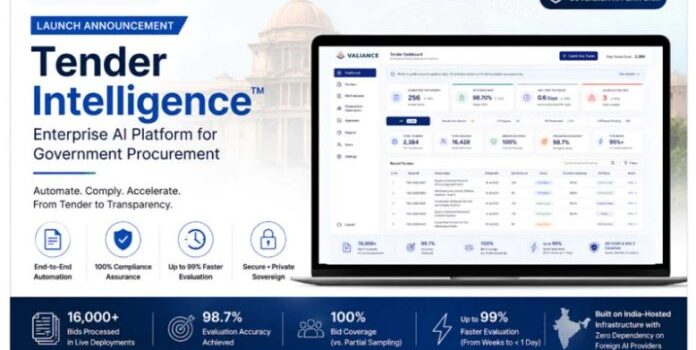
In response, Valiance Solutions recently announced the launch of Tender Intelligence, an enterprise SaaS platform designed to automate the complete tendering lifecycle and bring speed, structure, and compliance assurance to public procurement.
Developed as part of Valiance’s broader mission to deploy AI for large-scale national impact, Tender Intelligence is powered by the company’s proprietary, patented multimodal AI technology, capable of processing and reasoning across diverse data types, including scanned documents, structured tables, mixed-format files, and multilingual content. Built entirely on India-hosted, open-source AI models, the platform operates with zero dependency on foreign AI providers, ensuring full data sovereignty.
Proven at Scale in Live Government Deployments
Tender Intelligence is not a pilot system. It has already been deployed in production at one of India’s largest oil-sector PSUs, where it has processed over 16,000+ bids in real-world environments.
In one instance, the platform evaluated more than 500 bidders for a single tender, handling a scale of complexity that would be practically unmanageable through manual processes within any reasonable timeframe.
Across deployments, the platform has delivered over 98.7% accuracy, enabled 100% bid coverage compared to the limited sampling typical in manual reviews, and reduced evaluation timelines from weeks to under a day, representing a fundamental shift in procurement efficiency.
From Manual Burden to System-Driven Procurement
Tender Intelligence transforms procurement workflows by functioning as an end-to-end intelligence layer. Tenders are generated in alignment with GFR and organizational standards, ensuring completeness and consistency before publication. Approval workflows are validated against delegation of financial powers and regulatory requirements, creating a verifiable audit trail.
Once bids are submitted, the platform automatically retrieves documents from government portals, evaluates each submission against pre-defined criteria with cited evidence, and generates comprehensive, RTI-compliant comparative statements. Outputs are seamlessly integrated into ERP and document management systems, eliminating manual re-entry and preserving continuity across the procurement lifecycle.
The result is a transition from fragmented, document-heavy workflows to a unified, system-driven process where procurement officers shift from manual execution to informed oversight.
Enterprise SaaS Model for Nationwide Adoption
With its enterprise SaaS launch, Valiance is making Tender Intelligence accessible beyond large PSUs to government organizations of all sizes. Offered on a per-tender subscription model with a defined monthly minimum, the platform allows institutions to adopt and scale based on actual procurement demand, without the need for heavy upfront investment or per-user licensing.
This model ensures that a state department handling a moderate volume of tenders can access the same capabilities as the largest public sector enterprises.
Sovereign Infrastructure and Secure by Design
Tender Intelligence is a made-in-India sovereign AI platform engineered for secure deployment across MeitY-approved data centers, air-gapped environments, on-premises infrastructure, and cloud ecosystems.
Designed to meet the requirements of enterprise, government, and defense organizations, it ensures that all procurement data remains within India. The platform adheres to ISO 27001 and SOC 2 standards, aligns with public procurement policies and cybersecurity guidelines, and delivers enterprise-grade security, reliability, and compliance.
By eliminating reliance on external AI services and maintaining strict data isolation, the platform addresses one of the most critical concerns in government technology adoption: data security and control.
Early Impact on Procurement Outcomes
Initial deployments highlight a clear transformation in procurement operations. Where manual evaluation often leads to delays, partial coverage, and variability, Tender Intelligence enables consistent, comprehensive, and traceable analysis across all bids.
By reducing evaluation timelines by up to 99% while strengthening compliance assurance, the platform addresses one of the most persistent bottlenecks in public procurement, delivering both speed and accountability at scale.
Commenting on the launch, Vikas Kamra, CEO of Valiance Solutions, said:
“Public procurement was never designed to be executed manually at the scale we see today. Evaluation officers are expected to navigate complex rules, vast volumes of data, and strict compliance requirements simultaneously. Tender Intelligence was built to fundamentally change that equation, ensuring that every tender is processed not just faster but in full alignment with the frameworks that govern it. Our goal is to bring that level of assurance to every government organization in India.”
Valiance Solutions builds proprietary multimodal AI platforms for high-impact, real-world applications across public sector procurement, environmental conservation, healthcare, and enterprise operations. The company has been recognized by national and international institutions, including acknowledgment by India’s Prime Minister, and continues to focus on deploying AI systems where scale, compliance, and reliability are critical.
As India’s public procurement ecosystem continues to expand, platforms like Tender Intelligence signal a shift toward intelligent, system-driven governance, bridging the gap between digitization and true automation.
For demo requests, please contact marketing@valiancesolutions.com
For more details about the Tender Intelligence Platform, visit https://valiancesolutions.com/tender-evaluation/
For more information about Valiance Solutions, visit www.valiancesolutions.com.
Phone: +91 8178157404