
The case of Chairman Lee Man-hee before the Human Rights Council

On 30 September 2026, CAP Freedom of Conscience delivered an oral statement during the general debate under Item 3 of the 63rd session of the UN Human Rights Council, devoted to the promotion and protection of all human rights.

The statement raises the case of Chairman Lee Man-hee, the 95-year-old founder and leader of the Shincheonji Church of Jesus and a veteran of the Korean War, who is currently held in pretrial detention at the Seoul Detention Center in the Republic of Korea on non-violent charges.

CAP Freedom of Conscience expresses serious concern regarding what appears to be a politically driven and discriminatory investigation targeting a religious minority, as well as the conditions of detention. Despite his fixed residence and the absence of any flight risk, Chairman Lee was held in cells without air conditioning during Seoul’s most severe heatwave, raising grave concerns for the health of a 95-year-old detainee.

The statement recalls that such treatment runs counter to the Republic of Korea’s international obligations: Article 9 of the ICCPR requires detention to be necessary and proportionate; Article 10 guarantees humane treatment; the Nelson Mandela Rules entitle detainees to healthcare equivalent to that available in the community; the Tokyo Rules make pretrial detention a measure of last resort; and Article 18 protects freedom of religion or belief — a right CAP Freedom of Conscience considers disregarded in this case.

CAP Freedom of Conscience urges the Council to call on the Republic of Korea to honour its treaty obligations by offering alternatives to detention, allowing an independent medical assessment, and ensuring a fair and impartial trial.

Media Contact

CAP Liberté de Conscience (CAP LC)

117, Rue de Charenton, 75012 Paris, France
freedomofconscience.eu/cap-lc-contact

South Korean local government cancels international event with 30,000 participants from 78 countries, causing international damage

On October 29th, an administrative decision by a South Korean government agency sparked international controversy, raising concerns about religious freedom and causing substantial financial loss.

The “Religious Leaders Forum and Graduation Ceremony,” a joint initiative by two prominent religious organizations, was set to take place in Paju, South Korea. The event was expected to draw over 30,000 participants from 57 countries, including 1,000 religious leaders representing Christianity, Buddhism, Islam, and Hinduism.

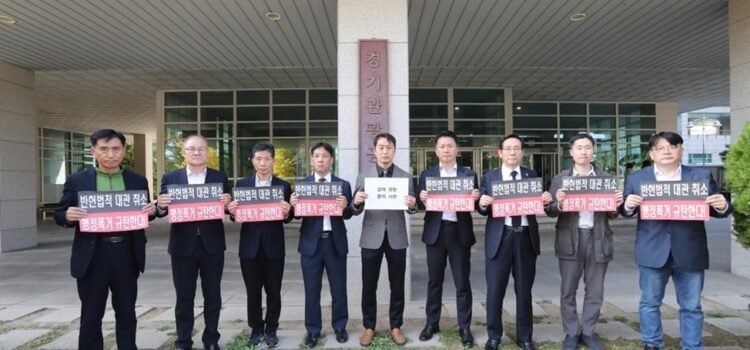
However, the Gyeonggi Tourism Organization, a public entity under Gyeonggi Province, abruptly canceled the venue rental without prior notice. This last-minute decision has resulted in significant financial damage to the international event. Organizers of this event stated that the cancellation constitutes an unconstitutional act of discrimination against a specific religion, violating religious freedom, human rights, and due process of law.

The hosting organizations, the Association for Buddhist National Unification of Korea and Shincheonji Church of Jesus, said that they had received official confirmation on October 23rd and 28th that there was no plan of cancellation. They also said that the unilateral cancellation was an unreasonable administrative action targeting a specific religious group. They further emphasize that other events scheduled for the same day were not affected, suggesting that the cancellation was “administrative decision caused by opposition from a specific religious group,” which “violates the principle of separation of church and state guaranteed by the Constitution.”

The Gyeonggi Tourism Organization cited security concerns related to recent North Korean actions and the planned activities of a North Korean defector group as reasons for the cancellation. However, it was pointed out that other events, such as civilian bike rides and foreign tourist visits to the DMZ, were permitted within the same designated area.

The incident has reignited international debate about religious freedom and tolerance in South Korea. The U.S. State Department’s International Religious Freedom Report has previously highlighted concerns such as the prosecution of Shincheonji Church of Jesus and the government’s refusal to approve mosque construction.

The Association for Buddhist National Unification of Korea and Shincheonji Church of Jesus call upon the South Korean government to respect religious freedom, uphold human rights, and rectify this unjust decision. They urge international organizations to monitor this situation and take appropriate action to protect religious freedom.