
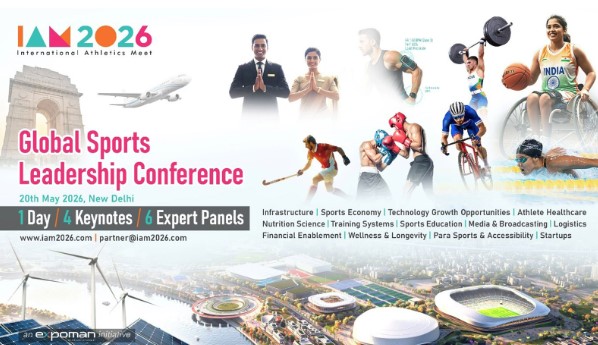
New Delhi [India], February 20: Expoman Group has announced the launch of the International Athletics Meet (IAM) 2026 – Global Sports Leadership Conference on “The New Sports Ecosystem”, to be convened on 20 May 2026 in New Delhi. The conference is positioned as a strategic national platform designed to reinforce India’s long-term sports infrastructure, governance frameworks, athlete development systems, and global event readiness, in alignment with the country’s preparations for the Commonwealth Games 2030 and its aspiration to host the Olympic Games in 2036.

India’s rising stature in global sport reflects the broader national development momentum under the vision of Vikasit Bharat, led by Hon’ble Prime Minister Shri Narendra Modi. The successful confirmation of the Commonwealth Games 2030 – supported by the Commonwealth Games Federation and the Indian Olympic Association – demonstrates international confidence in India’s institutional capacity, infrastructure standards, and governance preparedness. The leadership and forward-looking vision of the Hon’ble Prime Minister in strengthening sports as a pillar of national development merit acknowledgement and respect.

The International Athletic Meet 2026 has been conceived as a comprehensive ecosystem platform focused on strengthening the structural foundations required for sustained global sporting leadership. The conference will address sustainable and environmentally responsible infrastructure, professional facility management systems, governance, and compliance frameworks, public-private partnership (PPP) opportunities, sports technology integration, employment generation across sports-linked industries, hospitality preparedness for international delegations, high-performance athlete pathways, and inclusive participation models.

India’s sporting ambition today extends well beyond hosting tournaments. It encompasses green infrastructure aligned with global environmental benchmarks; operational excellence in stadium and venue management; integrated transport and mobility systems; sports tourism development; skilled workforce creation; sports medicine, rehabilitation and recovery ecosystems; analytics-driven performance monitoring; and expanded accessibility for para-athletes and persons with disabilities. IAM 2026 will convene policymakers, sporting bodies, investors, infrastructure developers, healthcare leaders, and industry stakeholders to align these interconnected priorities into a coherent and sustainable national roadmap.

The conference agenda reflects this integrated approach. Deliberations will focus on mega-event readiness, sustainability standards in infrastructure development, governance discipline in sports administration, PPP models for facility expansion, employment generation, hospitality integration, sports-tech innovation, medical and recovery systems, and inclusive frameworks that ensure accessibility and equal opportunity remain central to national planning.

The initiative is guided by a distinguished Advisory Board aligned with these objectives. Padma Shri Dr Niru Kumar strengthens the commitment to inclusive sports systems and para-sports ecosystem development through her recognised work in diversity, equity and inclusion and advocacy for persons with disabilities. Dr Prasoon M. Tripathi contributes expertise in governance architecture and talent frameworks to professionalise sports administration and management systems. Raman Krishnan supports leadership development and performance culture across coaching and athlete support ecosystems. Dr Vipin Sethi brings strategic insight into healthcare integration and long-term athlete sustainability. Talees Rizvi, CMD & Founder of Indian Conventions, serves as Knowledge Partner, ensuring structured alignment between policy direction, institutional capability, and investment ecosystems.

Gaurav Sharma, Founder, International Athletics Meet, https://iam2026.com stated:

“We express our profound respect for the leadership and vision of Hon’ble Prime Minister Shri Narendra Modi in bringing the Commonwealth Games 2030 to India and advancing our Olympic aspiration for 2036. This achievement reflects global confidence in India’s capabilities and places upon us a clear responsibility, to deliver infrastructure of international standard, management systems of excellence, environmentally sustainable facilities, inclusive opportunity for every aspiring athlete and governance framework that meet global expectations. The International Athletic Meet 2026 is our contribution towards strengthening that national preparedness and ensuring India stands as a benchmark destination for world sport.”

Sapana Sharma, Founder & Director, Expoman India Private Limited https://expomangroup.com, said:

“India’s sporting progress must be supported by disciplined planning, sustainable investment and coordinated execution. IAM 2026 seeks to bring together leaders committed to infrastructure excellence, employment generation, hospitality readiness, environmental responsibility, and inclusive growth.”

Talees Rizvi, CMD & Founder, Indian Conventions https://indianconventions.in , added:

“Sustained global credibility in sport depends upon the alignment of infrastructure, governance, talent development, and stakeholder collaboration. IAM 2026 has been structured as a knowledge-led platform to support India’s emergence as a professionally managed and globally respected sporting nation.”

The International Athletic Meet 2026, Global Conference is an initiative of Expoman Group with Indian Conventions serving as Knowledge Partner.

Event Details

International Athletics Meet (IAM) 2026 – Global Conference

20 May 2026 | New Delhi

For participation, partnerships, and media enquiries:

Website: https://iam2026.com

Email: partner@iam2026.com

Contact: +91 9310634007, +91 9873909991, +91 8860227114

In order to deliberate, ideate and devise strategies for promoting “Tourism in Mission Mode”, the Ministry of Tourism organized a two-day Chintan Shivir on March 28 and March 29 at New Delhi where all the States, Industry Associations and Industry leaders took part.

The agenda for discussions on the first day was set by Minister of Tourism, Culture and DONER, Shri G. Kishan Reddy. He outlined the vision of the Government to leverage tourism as a vehicle for socio-economic development, job creation and achieving sustainable development goals for the country. He stated that this is the most opportune moment to unveil a shared vision for future of India’s tourism, guiding its course for next 25 years to make India as the most sought-after travel destination in the world when India celebrates 100 years of Independence in 2047. He pointed out the three key pillars of developing tourism in mission mode – active participation of the States, Convergence of Government Programs and Public Private Partnerships. He stated that one major step would be to develop National Strategies and Models for providing guidance to the States in developing their tourism potential. The Ministry has recently formulated National strategies for development of various tourism sectors such as Rural Tourism, Adventure Tourism, MICE Tourism, Ecotourism, Medical Tourism, Sustainable Tourism.

Shri Arvind Singh, Secretary, Ministry of Tourism, Government of India stated that the 02 day Chintan Shivir will provide a platform to all stakeholders to conduct fruitful interactions and share good practices followed across the country and a stage to share unique  ideas involving technological solutions in travel sector, sustainability in tourism and responsible travel with the aim to take the benefits of tourism to the grass root level.

The first day`s agenda of discussions was divided into 6 Sessions deliberating on Incredible India@100 – Shared vision of Central Government, States and Industry, Policy Benchmarking and Ease of Doing Business, Investible Projects and Public Private Partnerships, “Global Best Practices and Capacity Building for Tourism Investments” by UNWTO, Developing MICE Tourism and Wedding Tourism and Innovation and Digitalization and Startups in Tourism Sector. Some of the key speakers were representatives from the industry stakeholders viz. FAITH, India Convention Promotion Bureau (ICPB) as well as from international organizations like World Tourism Organization (UNWTO) and the State Governments. UNWTO discussed the development of a Tourism Investment Strategy (TIS) through the UNWTO framework on Organizational, Attractiveness, and Promotion Strategy which will provide a structured approach to developing a comprehensive investment strategy that takes into account factors such as the local business environment, the potential for growth in the tourism industry, and the availability of financing options.

State of Rajasthan made a comprehensive presentation on granting of industry status to the tourism and hospitality sector along with benefits accrued to the industry from the same.

State Government of Maharashtra and Chhattisgarh showcased the investible projects in order to attract investment in tourism and hospitality sector. Union Territory of Lakshadweep Islands also shared successful case studies of public private partnership. In cognizance of the importance of the MICE sector as well as the Wedding Destination sector, a separate Session was kept on the two niche segments for deliberating on various policies, initiatives and strategies for development of MICE tourism and Wedding tourism in the Country. MICE Tourism brings higher revenue and year-round business for the destination overcoming seasonality. At the same time, MICE needs its own ecosystem before a destination can succeed as MICE destination. Wedding destinations are also fast emerging segment in India.

State of Telangana showcased how MICE tourism in the state of Telangana was being developed and promoted through the dedicated Hyderabad Convention Visitors Bureau.

During the event, the Ministry of Tourism also felicitated the States to recognize the best practices followed by them in six major categories under Swadesh Darshan Scheme.

The Government has recently announced to promote development of Tourism Sector in Mission Mode with active participation of the States and convergence of Government schemes and Public Private Partnership.

As an initiative of India`s G 20 Presidency, the Ministry of Tourism is organizing the 1st Global Tourism Investors’ Summit on May 17-19, 2023. Chintan Shivir will also provide opportunity to deliberate on the strategies and preparations for successful organization of 1st Global Tourism Investors’ Summit.

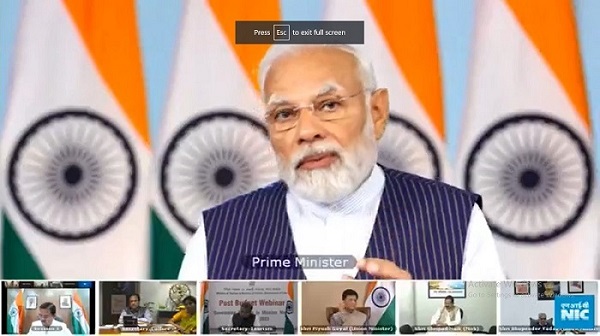
Prime Minister Shri Narendra Modi, On March 3, addressed the post-budget webinar on “Developing Tourism in Mission Mode’, organized by Ministry of Tourism. This is a series of post-budget webinars being organized by the Government with an aim to brainstorm ideas for effective implementation of the initiatives announced in the Union Budget-2023.

In his address, the Prime Minister, Shri Narendra Modi said that tourism has always been a part of our social and cultural civilization. India`s tourism comprises of multiple aspects and can be promoted as coastal tourism, wildlife tourism, adventure tourism, cultural tourism, beach, mangrove, Himalayan, spiritual tourism and others. This year`s Budget prioritizes the development of tourist destination in a holistic manner and it aims to develop at least 50 tourism destinations which can then be promoted globally. He stated that with the development of tourist amenities at destinations, the tourism sector will definitely flourish. As an example, with the reconstruction of the Kashi Vishwanath Temple corrido, 7 crore tourists have visited the city. Kashi Vishwanath Dham and Kedarnath Dham are live models highlighting the fact that ease of travelling encourages increased tourist footfall. Further technological advances and digitalization with better infrastructure and cleanliness will help to boost tourism. Apps for tourists and digital connectivity can be modernized to make it accessible to all tourists. There has been an increase in the number of foreign tourists visiting India. With a proper strategy to promote India globally, the footfall is also bound to increase substantially. The Union Budget 2023-24 has allocated an amount of Rs 2400 crores to the Ministry of Tourism.

Prime Minister described Destination Weddings as an upcoming niche and emerging sector which had the potential for increasing tourism. The exchange of intercultural wedding rituals amongst the States can boost the sector further. Further events like global Conferences and sporting events has the potential to create stupendous level of infrastructure. He cited the example of the recent FIFA World Cup 2022, which benefitted Qatar`s economy massively.

The Post Budget Webinar had 6 breakout sessions deliberating on Destination Centric Approach for Tourism Development, Convergence – The Power of Collaboration, Strengthening Public Private Participation in Tourism Sector, Driving Innovation and Digitalization in Tourism Sector, Impacting lives at grass root level through Tourism and Cultural Heritage for Promotion of Tourism. The sessions saw active participation from different panelists from State, Central Ministries as well as Industry associations, District administrations, local bodies, experts in the field of tourism and hospitality, Invest India etc.

Speaking at the concluding session, Minister of Tourism, Shri G. Kishan Reddy thanked Prime Minister for showing the path for developing tourism sector in mission mode as well as all the panelists and speakers for their suggestion and ideas to overcome the challenges and move towards implementation of the budget announcements. He stated that the biggest employment generating sector could very well be the tourism sector after textiles industry. Government of India, state governments, private stakeholders and civil society should closely work together to promote the tourism industry of the country. This sector is one of the sectors to generate maximum employment with the least capital investment, he said.

Secretary Tourism, Shri Arvind Singh on the occasion said that this year’s budget has given us new vision for tourism development and it focuses on promotion of tourism in mission mode, with active participation of states, convergence of government programmes and public-private partnerships. He also said that the budget proposes facilitation of tourism infrastructure and amenities in border villages under the Vibrant Village programmes and encourages setting up a Unity Mall in the state capital or most prominent tourism center or the financial capital for promotion and sale of their own ODOPs (one district, one product), GI products and other handicraft products, and for providing space for such products of all other States.

Shri Arvind Singh highlighted the fact that this year’s budget advocates a shift from department centric and scheme centric approach to a destination centric approach for planning, development and management of tourism

On the occasion Secretary Culture, Shri Govind Mohan said that the Ministry of Culture has the basic objective of preserving, disseminating and also promoting Indian Culture and Indian culture is a very rich repository of ideas, of places, of facets of our heritage, of performing arts, visual arts, monuments which are of immense interests to the tourists not only within India but also abroad.

He also informed that to begin with the Ministry of Culture will develop 5 big cultural spaces in India and going forward more spaces will be developed. These are the places where the tourists will be exposed to the best of Indian music, dance performances, book reading, painting competitions, quizzing competitions and other cultural activities in the integrated fashion.

Secretary Culture also highlighted the importance of technology and said that using AI, VR and other digital techniques the monuments can be developed as more interesting places for the younger generation. He also said that PPP’s have the potential creating value around these monuments and make them living example of wealth and beauty India offers.

A number of suggestions and ideations emanated from the deliberations, which are broadly as follows :-

  1. Planning of the destinations is crucial for the development of the destinations. The model on the lines of Ekta Nagar needs to be replicated.
  2. Destination Management is important which should be done taking into account the government agencies, private partners and local communities.
  3. It is important to device a mechanism which institutionalizes an enabling framework for promoting public private partnership in the tourism and hospitality sector.
  4. Expeditious role of national digital tourism mission which can provide a similar tourism interface between tourism stakeholders and services to the tourists. Convergence of skilling, capacity building and enterprises development at the destination for various cutting edge job opportunities in tourism and hospitality sectors.
  5. Promoting ease of doing business particularly for hospitality sector which is to take various promotions from multiple departments and agencies from the government. Visitor management system should be in place to manage over crowing at the destinations. There is a need to introduce courses of skilling of tour guides across the country and at all the destinations.
  6. India has innumerable heritage monuments which can attract domestic and foreign tourists provided they have quality tourist amenities and tourist experiences. Specific schemes should be introduced for such tourism centric development at these heritage sites.

Link of the webinar : https://youtube.com/live/cOYm5okQjp0?feature=share