
New Delhi [India], June 19: India’s digital payments revolution, powered by the Unified Payments Interface (UPI) and a rapidly expanding base of digital wallet and Prepaid Payment Instrument (PPI) users, has made small-value, app-based payments a part of everyday life for hundreds of millions of Indians. Digital wallets are now used for everything from daily commute and grocery payments to recharges, bill payments and merchant transactions, making the balance and transaction limits attached to them a matter of direct, practical interest to consumers.

  • 63% of digital wallet users surveyed want RBI to retain or increase wallet limits while 23% believe limits should depend on the level of KYC/authentication completed by the user
  • 62% of digital wallet users surveyed say reducing the amount that can be stored or transacted via wallets would inconvenience their everyday payments; 38% believe lower limits won’t curb fraud and will only penalise genuine users
  • Nationwide survey receives 43,000 responses from users of digital wallets across 304 districts of India

Against this backdrop, the Reserve Bank of India (RBI) in April 2026 released a draft Master Direction on Prepaid Payment Instruments (PPIs), 2026, for public comments, replacing its August 2021 framework, with the consultation window open till May 22, 2026. While the draft raises the maximum outstanding balance for Full-KYC wallets to ₹2 lakh, it also proposes to sharply cut the monthly cash top-up limit for such wallets from ₹50,000 to ₹10,000, introduces a uniform ₹25,000 monthly cap on person-to-person transfers, mandates UPI and card-network interoperability, requires immediate refunds for failed transactions and imposes tighter compliance norms on issuers, citing rising fraud and anti-money-laundering concerns.

The proposed reduction in how much money can be loaded into and moved through digital wallets has drawn considerable attention from users and industry alike, with many arguing that genuine, everyday users could be inconvenienced even as the changes do little to deter determined fraudsters. To understand how digital wallet users view these limits, LocalCircles conducted a large survey seeking their direct opinion on whether the RBI should reduce, retain or increase wallet limits, and how a reduction would affect them.

The survey received over 43,000 responses from users of digital wallets across 304 districts of India and found that an overwhelming majority of digital wallet users are against any reduction in wallet limits. 63% of those surveyed want the RBI to retain or increase limits, only 7% support reducing them, and 23% believe limits should depend on the level of KYC/authentication done by the user. Further, 62% say they would be inconvenienced if limits were reduced, and 38% believe that reducing limits will not curb fraud, but instead penalise genuine users. The detailed findings are summarised below.

63% of digital wallet users surveyed believe RBI should retain or increase limits; 23% believe limits should depend on level of KYC/authentication

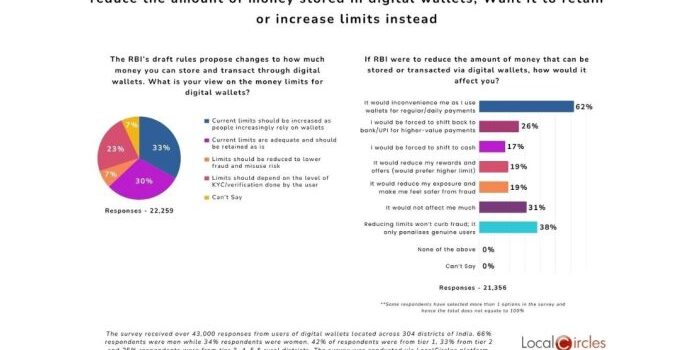
With the RBI’s draft rules proposing changes to how much money can be stored and transacted through digital wallets, the survey first sought users’ view on the money limits for digital wallets. In response, 33% said current limits should be increased as people increasingly rely on wallets, while 30% said current limits are adequate and should be retained as is – taking the share that wants limits retained or increased to 63%. Another 23% felt limits should depend on the level of KYC/verification done by the user, and only 7% said limits should be reduced to lower fraud and misuse risk, while 7% could not say. This indicates that a large majority of users see digital wallets as a growing necessity rather than a risk to be curtailed. This question in the survey received 22,259 responses.

62% of digital wallet users surveyed believe that they would be inconvenienced if RBI reduced the amount of money that can be stored or transacted via digital wallets; 38% also believe reducing limits won’t curb fraud but penalise genuine users

The survey next asked digital wallet users how it would affect them if the RBI were to reduce the amount of money that can be stored or transacted via digital wallets. In response, 62% said it would inconvenience them as they use wallets for regular/daily payments, 26% said they would be forced to shift back to bank/UPI for higher-value payments and 17% said they would be forced to shift to cash. Among the respondents, 19% felt it would reduce their rewards and offers, another 19% felt it would reduce their exposure and make them feel safer from fraud, 31% said it would not affect them much. Importantly, 38% of users stated that reducing limits won’t curb fraud and will only penalise genuine users. This question in the survey received 21,356 responses. (Some respondents selected more than one option and hence the total does not equate to 100%.)

To summarise, the survey makes it clear that digital wallet users overwhelmingly do not want the RBI to reduce the amount of money that can be stored or transacted via digital wallets. With 63% of users wanting limits retained or increased and only 7% in favour of a reduction, the message from consumers is that digital wallets have become an everyday financial tool rather than a fringe convenience. As wallet usage deepens across tier 1, tier 2 and smaller towns, users appear to view higher or stable limits as essential to managing their daily payments seamlessly.

The concern around the proposed reduction is rooted in real-world impact. 62% of users say a reduction would inconvenience their regular payments, while sizeable proportions say they would be pushed back to bank/UPI for higher-value payments (26%) or even to cash (17%) – an outcome at odds with the broader push towards a digital, less-cash economy. With 38% of users asserting that lower limits won’t curb fraud and will only penalise genuine users, there is clear scepticism about whether reducing limits, particularly the sharp cut in monthly cash top-up from ₹50,000 to ₹10,000 proposed in the draft PPI Directions, will achieve its stated objective.

LocalCircles will be escalating these survey findings with the RBI and other stakeholders as part of the public consultation on the draft Master Direction on Prepaid Payment Instruments, 2026. While users broadly welcome measures that improve security, interoperability and faster refunds, the survey suggests that the central bank should reconsider any reduction in wallet storage and transaction limits, and instead consider retaining or increasing them – potentially linking higher limits to the level of KYC/authentication completed by the user, an approach 23% of users have endorsed.

Survey Demographics

The survey received over 43,000 responses from users of digital wallets located across 304 districts of India. 66% respondents were men while 34% respondents were women. 42% of respondents were from tier 1, 33% from tier 2 and 25% respondents were from tier 3, 4, 5 & rural districts. The survey was conducted via LocalCircles platform, and all participants were validated citizens who had to be registered with LocalCircles to participate in this survey.

About LocalCircles

LocalCircles, India’s leading Community Social Media platform enables citizens and small businesses to escalate issues for policy and enforcement interventions and enables the Government to make policies that are citizen and small business centric. LocalCircles is also India’s # 1 pollster on issues of governance, public and consumer interest. More about LocalCircles can be found on http://www.localcircles.com

Media Contact: media@localcircles.com, +91-8585909866
New Delhi [India], June 18: The Central government primarily through food regulator, the Food Safety & Standards Authority of India (FSSAI), has taken some steps to crack down on food products selling online by enforcing the Food Safety act which requires products listed for sale online to have atleast 30% shelf life remaining. However, 1 in 2 consumers surveyed by LocalCircles still can’t find “Best Before” or expiry date information listed online as mandated in the Legal Metrology Packaged Commodity Rules 2018 amendment.

  • LocalCircles writes to FSSAI again about amending act and ensuring compliance
  • 48% consumers report being unable to find Best Before Date information; Only 9 percentage points improvement from 2024 to 2026
  • Zepto, Swiggy Instamart, Blinkit, Jiomart and Milk Basket all non-compliant; Only Amazon Now, Flipkart and Big Basket display best before dates
  • Consumers cite hundreds of cases of near expiry date products being received

Under the Legal Metrology (Packaged Commodities) Amendment Rules, 2018, all packaged human consumption products listed on e-commerce sites/apps must display clear “Best Before” or “Use By” dates, with day, month, and year, at the point of digital sale. However, since food as a subject has been governed by FSSAI, Legal Metrology has not been enforcing this clause of displaying best before date online for such products.

FSSAI, to which LocalCircles has written twice since 2024 is yet to enforce compliance by online grocery platforms. Instead, it has been trying to enforce its Food Safety Law 2020 amendment which calls for e-commerce/quick-commerce platforms having at least 30% of packaged food product’s shelf life remaining or 45 days before expiry, at the time of delivery. However, there is no way for the consumer to check the shelf life before ordering packaged foods with most of these platforms, despite it being in the PCR 2017 amendment.

Following the LocalCircles escalation in October 2024, FSSAI formally issued warnings to some quick commerce and e-commerce platforms to stop selling consumables with missing or near-expiry dates. Platforms were asked to only list products meeting the 30% or 45 day criteria or face punitive action. However, no directions were issued by FSSAI to platforms to display best before dates online on the app/website.

Some consumers have even alleged some online grocery platforms engaging in the practice of buying inventory with small shelf life left and listing it on their platform at a high discount, in violation of the 30%- or 45-day shelf life rule. One of the most common examples reported on LocalCircles is that of bread where the product delivered often has 1-2 days of shelf life remaining while the average shelf life is 5-7 days.

LocalCircles through a follow on survey has strived to find out from consumers what has been their experience of Best Before Date display compliance on online grocery platforms and whether the situation has improve since 2024. The survey received over 17,000 responses from consumers of online platforms located in 164 districts of India. 61% respondents were men while 39% respondents were women. 53% respondents were from tier 1, 29% from tier 2 and 18% respondents were from tier 3 & 4 districts.

48% Indian online grocery platforms shoppers surveyed say they still cannot find date (for human consumption products) displayed on most platforms

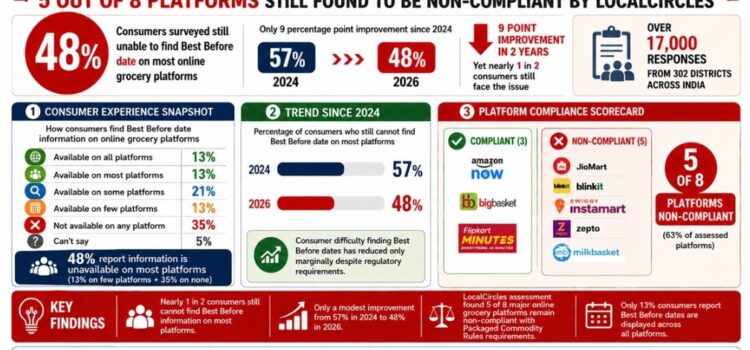
The survey asked consumers, “When you shopped on online grocery platforms in the last 12 months, how did you find the Best Before date (shelf life remaining) of the human consumption products (packaged food, groceries, medicines, cosmetics, etc.,) displayed online?” Out of 17,133 who responded to the question 13% stated the “Best Before date was displayed on all apps/sites”; 5% of respondents stated ““Best Before date was displayed on most apps/sites”; 21% of respondents stated “Best Before date was displayed on some apps/sites”;13% of respondents stated “Best Before date was displayed on just a apps/sites”; 35% of respondents however stated that they “could not find Best Before date on any apps/site”; and 13% of respondents did not give a clear answer. To sum up, 48% Indian online grocery platforms shoppers surveyed say they still cannot find Best Before date (for human consumption products) displayed on most platforms.

Minor improvement observed in display of best before dates by online grocery platforms; 1 in 2 consumers surveyed still can’t find it

A comparison with the study results of 2024 and this year shows that there has been minor improvement in the display of ‘Best Before’ dates by online grocery platforms as non-compliance has dipped from 57% to 48%. However, 1 in 2 consumers surveyed still can’t find it on most platforms.

Majority online platforms selling packaged foods continue to not display best before date as required under Packaged Commodity Rules Amendment 2018

Based on consumers’ complaints and LocalCircles’ study out of 8 major online grocery platforms, 5 have been found to be non-compliant with the requirement that Best Before date should be displayed on all packaged food products sold through the platform. Among those found to be compliant are Amazon Now, BigBasket, and Flipkart Minutes, while those found non-compliant are Milkbasket, JioMart, Blinkit, Swiggy Instamart, and Zepto. Some of these platforms instead of providing a Best Before Date or a Manufacturing Date with Shelf Life, just provide Shelf Life which is meaningless as it does not tell the consumer when the product expires. Below are some examples of products sold through various online grocery platforms – some which have Best Before Date displayed and others where this information is not available.

In summary, 48% of Indian online grocery shoppers surveyed say they still cannot find Best Before date (for human consumption products) displayed on most online platforms. However, there has been minor improvement observed in display of Best Before dates by some platforms. Despite the improvement, 1 in 2 consumers surveyed still can’t find it.

LocalCircles was instrumental in the original development, implementation and compliance tracking of Legal Metrology Packaged Commodity Rules 2017 amendment as well as the modification of food safety laws from an eCommerce perspective. Following the LocalCircles survey in October 2024, which revealed an increasing number of consumers purchasing food products online being unable to see the best before date of the products, the platform had repeatedly escalated with FSSAI the need for ensuring the display of best before date for human consumption products on online platforms. Though considerable time has passed since the last submission to FSSAI in January 2026, the Best Before Date is not being displayed on online platforms for such products.

The LocalCircles submission to FSSAI said that the Food Safety and Standards Amendment Regulation 2020 should be implemented in letter and spirit with the regulator ensuring compliance. The authority should ensure that sellers/platforms must only display foods that have 30% or higher shelf life or 45 days for sale and update the law to mandate display of Best Before Dates online for all packaged food products.

Alternatively, LocalCircles had urged the authorities that in the event of FSSAI is unable to update their act in a timely manner, the clause that exempts food products in PCR 2017 amendment of legal metrology should be revoked such that consumers have this information available to them when purchasing food products online. This will ensure that just like in physical retail stores where the consumer has the benefit of seeing the expiry date of products when buying, they have the same information available when buying online.

LocalCircles plans to share the findings of this new survey with FSSAI, Legal Metrology and CCPA so the necessary changes can be made along with enforcing such that every online grocery platform complies and displays best before date for all human consumption products on their apps.

Survey Demographics

The survey received over 17,000 responses from consumers of online platforms located in 164 districts of India. 61% respondents were men while 39% respondents were women. 53% respondents were from tier 1, 29% from tier 2 and 18% respondents were from tier 3 & 4 districts. The survey was conducted via LocalCircles platform, and all participants were validated citizens who had to be registered with LocalCircles to participate in this survey.

About LocalCircles

LocalCircles, India’s leading Community Social Media platform enables citizens and small businesses to escalate issues for policy and enforcement interventions and enables the Government to make policies that are citizen and small business centric. LocalCircles is also India’s # 1 pollster on issues of governance, public and consumer interest. More about LocalCircles can be found on http://www.localcircles.com

Media Contact: media@localcircles.com, +91-8585909866